Video Presentation
Abstract
In this paper, we explore the overlooked challenge of stability and temporal consistency in interactive video generation, which synthesizes dynamic and controllable video worlds through interactive behaviors such as camera movements and text prompts. Despite remarkable progress in world modeling, current methods still suffer from severe instability and temporal degradation, often leading to spatial drift and scene collapse during long-horizon interactions. To better understand this issue, we initially investigate the underlying causes of instability and identify that the major source of error accumulation originates from the same scene, where generated frames gradually deviate from the initial clean state and propagate errors to subsequent frames. Building upon this observation, we propose a simple yet effective method, StableWorld, a Dynamic Frame Eviction Mechanism. By continuously filtering out degraded frames while retaining geometrically consistent ones, StableWorld effectively prevents cumulative drift at its source, leading to more stable and temporal consistency of interactive generation. Promising results on multiple interactive video models, e.g., Matrix-Game, Open-Oasis, and Hunyuan-GameCraft, demonstrate that StableWorld is model-agnostic and can be applied to different interactive video generation frameworks to substantially improve stability, temporal consistency, and generalization across diverse interactive scenarios.
Why Interactive Video Generation Becomes Unstable?
Long-horizon interactive video generation often suffers from spatial drift and scene collapse. We find that a major source of instability is error accumulation, especially within the same scene: small drifts accumulate under the same viewpoint, eventually leading to the collapse of the entire scene.
This perspective is different from the commonly discussed error accumulation caused by the train–inference mismatch, and we find that scene collapse is largely driven by this factor.

Small drifts may seem negligible at first, but when repeatedly accumulated under the same viewpoint, they gradually grow and eventually lead to severe scene collapse.
When the scene changes extremely rapidly (e.g., multiple visual changes per second), errors do not have sufficient time to accumulate, resulting in much less frequent scene collapse.
Overall Framework of StableWorld
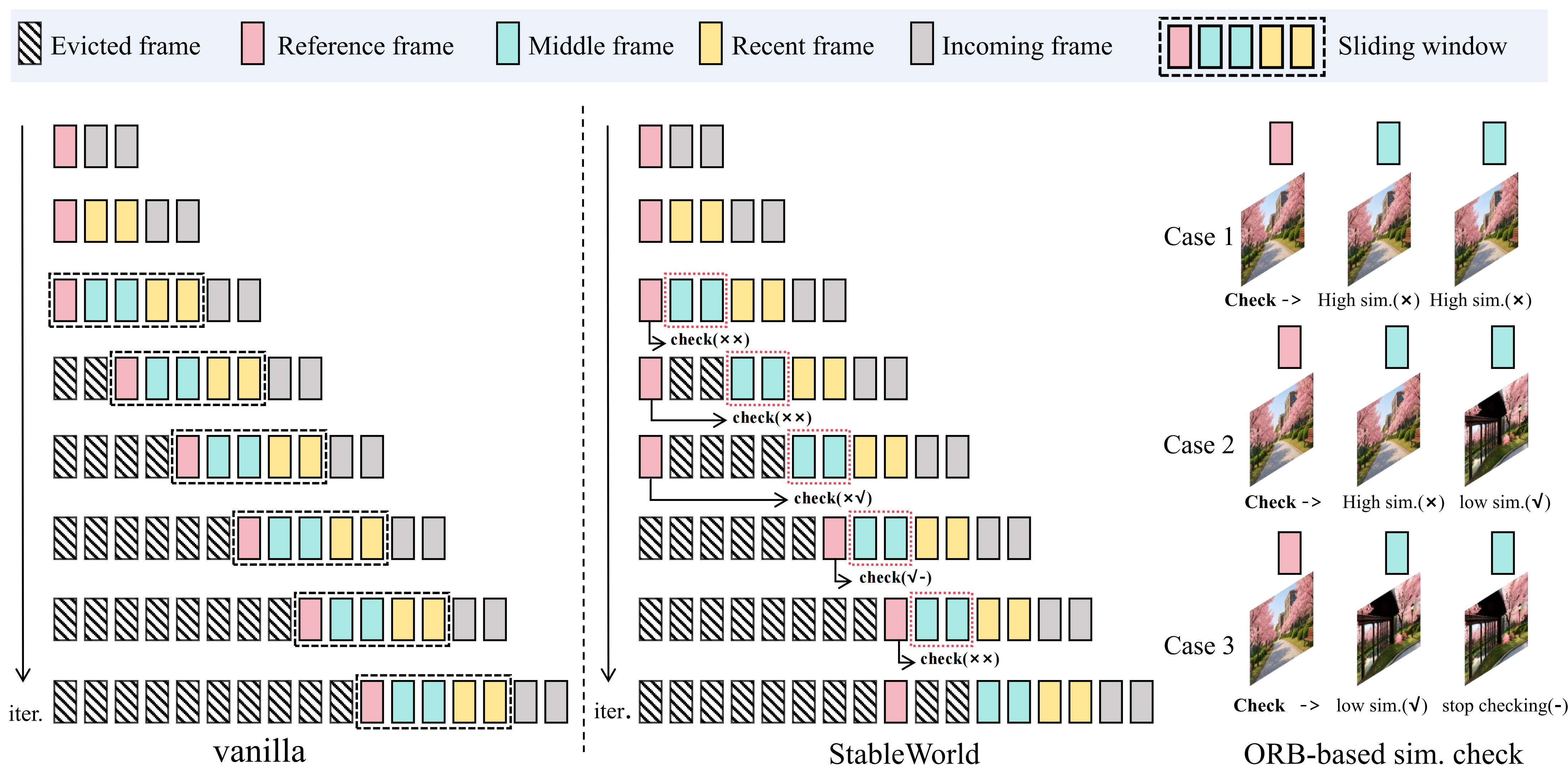
StableWorld dynamically evicts degraded frames while retaining geometrically consistent frames to prevent cumulative drift and improve temporal stability in interactive video generation.
Visual Results
@article{stableworld2026,
  title={StableWorld: Towards Stable and Consistent Long Interactive Video Generation},
  author={Ying Yang and Zhengyao Lv and Tianlin Pan and Haofan Wang and Binxin Yang and Hubery Yin and Chen Li and Ziwei Liu and Chenyang Si},
  journal={arXiv preprint arXiv:2601.15281},
  year={2026}
}